AI Is a Language: Why Learning the Framework Beats Memorizing Prompts
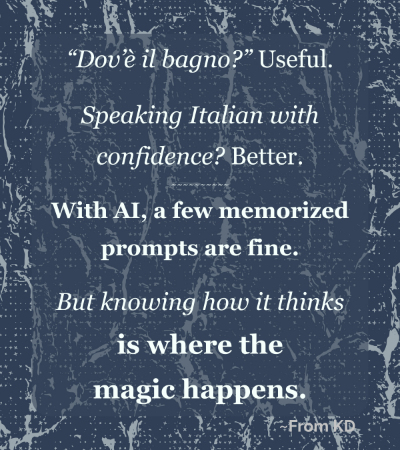
Picture this: you’re headed to Italy. You memorize a handful of essential phrases.
- “Dov’è il bagno?”
- “Quanto costa?”
- “Vorrei un gelato.”
These lines are useful. They’ll get you through a gelato emergency or a bathroom crisis. But what if you want to ask for directions, bargain at the market, or figure out which train goes to Florence? Memorized phrases won’t help much. You need the grammar, the sentence structures, and a little confidence to improvise. The same principle applies to AI. AI is a language.
Memorizing Prompts: Handy, but Limited
Many people approach AI as a magic box: they memorize prompts that “worked last time.”
“Explain blockchain like I’m 12.”
“Summarize this article in five bullet points.”
“Create a daily workout plan for a beginner.”
These prompts can get useful outputs, sure. But when the context changes—different content, audience, or goal—the memorized prompt starts to fall apart. You end up tweaking endlessly, hoping the AI produces something usable. Frustrating? Yes. Predictable? No.
Learning the Framework: Your AI Grammar
Just like learning a language, understanding the frameworks behind AI prompts is transformative. Instead of relying on rote memorization, you learn:
- Structure: how to give the AI context, constraints, and style instructions.
- Sequencing: how to guide it step-by-step instead of dumping all instructions at once.
- Adaptation: how to modify your approach for different tasks, audiences, or domains.
Armed with these skills, you can handle new situations easily—just like forming a sentence in Italian you’ve never spoken before.
Real-World Example
Imagine you’re a teacher preparing a lesson on climate change. Instead of searching “Create a lesson plan like I’m 12,” you use your AI framework knowledge:
- Specify the grade level.
- Specify the objective (students understand greenhouse gases).
- Ask for three types of activities (discussion, project, homework).
- Include time constraints.
Result? A usable, flexible lesson plan. One that can be adapted, expanded, or simplified. Memorizing a prompt wouldn’t get you that.
Why Humor Helps
Here’s the fun part: learning a framework makes AI feel less intimidating. It’s like learning basic Italian verbs. Suddenly ordering dinner or asking directions isn’t terrifying anymore.
And yes, “Dov’è il bagno?” is still important. But understanding how to form new sentences? That’s what separates the lost tourist from the confident explorer. And the frustrated prompt-memorizer from the productive AI user.
Takeaway
If you want AI to be genuinely useful, don’t just memorize prompts. Learn the underlying framework. Think in structures, sequences, and constraints. Approach it like learning a new language, not memorizing a tourist phrasebook.
Your AI experience will be faster, more reliable, and yes, much more fun. And if you want a little with that process, From KD guides walk you through learning how to use AI, the “grammar of AI,” effectively. So you can prompt like a pro, no Italian vacation required.
Now available: Using AI Effectively — Beginner, Intermediate, and Advanced Guides
Guides for you to learn how to get a leg up on the competition. (Or just use the technology effectively enough to help with your home maintenance schedule.)