
Why Being Curious (Or Revitalizing Your Curiosity) Matters So Much
Curiosity isn’t childish. It’s a powerful tool for learning, adaptability, and success.
Children are curiosity machines. They ask “why” about everything: the sky, the dog, the toaster. Somewhere along the way, adults stop being curious. Maybe it’s fear of looking clueless. Maybe it’s the endless distractions of modern life. Or maybe it’s because we think Google has all the answers anyway.
Being curious isn’t childish, it’s essential. It keeps your brain sharp, your work adaptable, and your life interesting. Without it, you risk turning into the person who still thinks QR codes are “a passing fad.”
What Happens When Curiosity Fades
When you stop asking questions, you stop growing. Adults often trade curiosity for efficiency. “Just tell me what I need to know.” But that shortcut comes at a cost. It keeps you from noticing new ideas, fresh opportunities, and the small changes that compound into big shifts.
Neuroscience backs this up. Research shows curiosity activates dopamine, the brain’s “reward chemical.” Translation: when you’re curious, you’re not only more motivated to learn, you’re more likely to remember what you’ve learned. Curiosity literally makes knowledge stickier.
Curiosity as a Competitive Advantage
In work and life, curiosity is leverage. The colleague who asks, “Why do we do it this way?” will always uncover inefficiencies faster than the one who nods and accepts the status quo.
That’s how organizations avoid becoming Blockbuster, which was blindsided by Netflix. Or Blackberry, which shrugged off the iPhone because “real business people need keyboards.” Curiosity looks naive at first. In reality, it’s foresight.
How to Revive Curiosity If You’ve Lost It
Curiosity isn’t gone, it just needs a tune-up. Here are a few simple ways to bring it back:
- Ask the “dumb” question. Chances are that half the room doesn’t know either. They’re just better at serious nodding.
- Switch off autopilot. Notice details in your routine: why your team does something a certain way, why your commute follows that route, why the software update suddenly made things harder.
- Cross-pollinate. Pick up a hobby or subject unrelated to your work. Curiosity thrives when you explore outside your lane. Yes, even medieval bread-baking might teach you something about project management.
The Real Payoff
Curiosity keeps your brain plastic (literally reshaping neural pathways), your conversations engaging, and your skills future-proof. It’s not just a personality trait; it’s a survival strategy in a world where entire industries can change overnight.
And it comes with a bonus. Curious people are simply more fun to be around. At work, at dinner, or at a random trivia night. Curiosity is the invisible magnet that keeps ideas flowing.
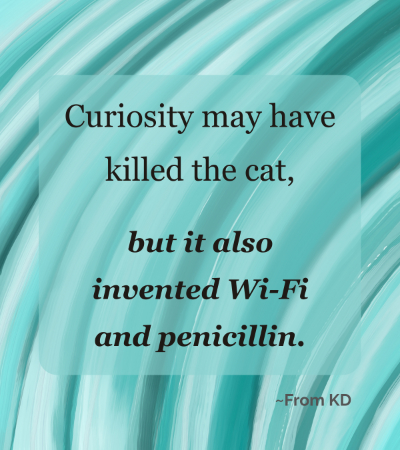
So, the next time your brain whispers, “Don’t ask. You’ll sound dumb,” ask anyway. Curiosity may have killed the cat, but it also gave us penicillin, Wi-Fi, and your favorite streaming shows. Not a bad trade.
Want to sharpen your thinking beyond being more curious? From KD critical thinking guides will help you learn to use your own judgement more effectively, make decisions better, and question the things that don’t make sense.
Browse all From KD Critical Thinking guides