
The “And Then What?” Test: A Simple Thinking Tool That Reveals Consequences
We’ve all seen it happen. Someone makes a decision that seems brilliant in the moment… until reality shows up with a clipboard and says, “Really? You didn’t think this through?”
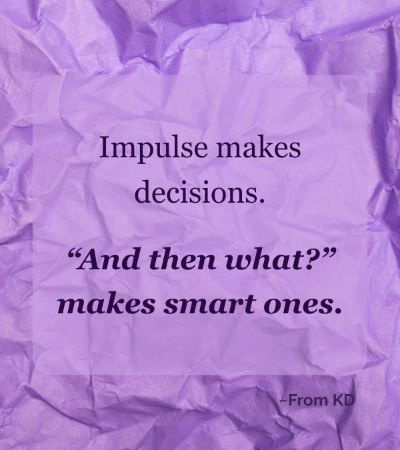
Enter the “And Then What?” Test. It’s not fancy. It doesn’t require software, consultants, or whiteboards covered in hieroglyphics. It’s just a question. “And then what?”
How It Works (In Plain English)
You make a choice. Then ask: And then what? Repeat until you’ve either found clarity… or realized you’re about to light a dumpster fire.
Example:
- “We’ll offer a 70% discount to attract new customers!”
- And then what? — “We’ll get lots of sales.”
- And then what? — “We’ll train people to only buy when it’s cheap.”
- And then what? — “We’ll go broke.”
See? A few rounds of “And then what?” can save you from a very sad bottom line.
The Serious Science Bit (Lightly Served)
Psychologists call this kind of thinking consequential reasoning. It’s the skill of projecting forward to anticipate outcomes. Research shows that people who practice it regularly make better decisions and handle uncertainty more effectively.
It’s like a mental time machine that helps you dodge avoidable disasters.
Everyday Examples
- Personal: “I’ll skip sleep and finish this project tonight.” And then what? — “I’ll look productive.” And then what? — “I’ll write emails that read like a toddler with a keyboard.”
- Work: “We’ll launch the new software before testing.” And then what? — “We’ll look fast.” And then what? — “We’ll also look broken.”
- Life: “I’ll get a third cup of coffee.” And then what? — “I’ll feel awake.” And then what? — “I’ll also start vibrating at Wi-Fi frequency.”
How to Practice It
- Pause before action. (Harder than it sounds, but crucial.)
- Ask “And then what?” at least 3 times. By round 3, things get clearer.
- Play it out both ways. Best-case and worst-case. You’ll see which is more likely.
- Decide with eyes open. If you still want to drink that third coffee, fine. But at least you know you’re signing up for the jitters.
The Bottom Line
The “And Then What?” Test is deceptively simple. But it’s a practical way to slow impulsive thinking and realise long-term consequences… before they sneak up on you. Because in work, in life, and yes, in caffeine choices, the real question isn’t what now? It’s always and then what?
Clear thinking is a quiet skill, but it has loud results.
Ready to sharpen yours?
Browse all From KD Critical Thinking guides