“Explain It Like I’m 5”: Why Is That the Internet’s Favorite Learning Age?
You’ve seen it, right? One of the most common prompts for learning something on the Internet. “Explain it like I’m 5.”
- “Explain quantum computing like I’m 5.”
- “Break down the stock market like I’m 5.”
- “Teach me Python like I’m 5.”
Five. Not 30. Not 8. Not “like I’m your Aunt Kenna, who’s great with words but never installed a browser extension in her life.” Nope. Always 5. (Or sometimes, “like I’m 12”—as if that’s the more mature version.)
Apparently, the Internet’s favorite way to learn is by role-playing a kindergartner with curiosity and a data plan.
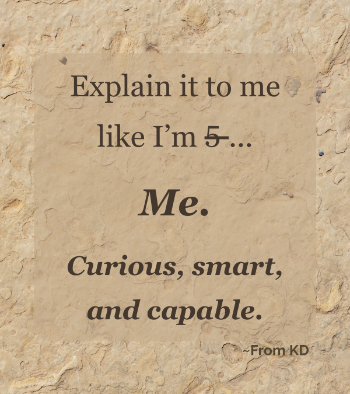
Here’s a thought: What if 5 (or 12) isn’t the most helpful baseline? What if we’re all just… weirdly defaulting to an imaginary smart-kid persona to avoid admitting we’re adults who didn’t grow up with AI, code, or algorithms?
I don’t know about you, but when I want to learn something new, I don’t need it explained like I’m in finger-painting class. I want it explained like I’m me—a well-read, intelligent, experienced person who just happens to have missed the boat on APIs and transformer models.
What if we said:
- “Explain AI safety like I’m a copy editor with a college degree and a healthy distrust of hype.”
- “Explain JavaScript like I’m an observant adult who once ran a business but has never opened a dev console on purpose.”
- “Explain blockchain like I’m a teacher who loves logic puzzles, but not buzzwords.”
See? Still clear. Still human. Way less weird.
Why We All Do This
The “like I’m 5” trope isn’t lazy prompting. It’s a cultural reflex. A shortcut we use when we’re smart in some areas, but don’t want to admit we’re lost in others. So we downshift. Way down.
- “Pretend we’re 5.”
- “Don’t make me Google four new acronyms.”
- “Act like I just landed on this earth.”
- “Make it make sense.”
But real learning doesn’t need that little game. You don’t have to pretend to be a kid to ask for clarity. You have to be honest about what you need—clarity, patience, and some decent metaphors that don’t involve Legos.
So the next time you want to learn something new, try being more honest in your prompt. Not dumber. Just you-er. Because you’re not 5. You’re just asking the right questions.
PS: Want to learn without dumbing yourself down?
That’s kind of my thing. From KD guides are made for intelligent people who just need smart topics explained in clean, calm language, without condescension or cringe.
Explore my Critical Thinking guides or Using AI Effectively guides (aka, “AI for People Who Don’t Want to Pretend They’re 5.”)
Note: If you’re interested in all 3 Using AI Effectively guides, I’ve bundled them for a discount. Grab the bundle here.